Showing posts with label Film. Show all posts

Monday, April 2, 2012

Thoughts on "D.O.A."

 photo doa-movie-title_zpsb8a0523d.jpg

Spoilers...

D.O.A. (1950) directed by Rudolph Maté.

This minor noir stars Edward O’Brien, as Frank Bigalow. He’s a businessman of some sort who does notaries. His confidential secretary Paula is also his lover. She wants to get married, but he just isn’t ready to take it to the next level. He decides to go to San Francisco for a week without her. She believes to sow his wild oats. But she tells him “You don’t have to ever feel guilty about anything you do there.” Bigalow takes her advice and oogles women and goes to a jazz club, but after hitting on a woman and arranging a date later, he just can’t betray Paula.

However, when his stomach hurts the next morning he goes to a doctor and finds out that he was poisoned the night before. He has luminous poisoning and he’s going to die in a day or two or a week. What is luminous poisoning? I don’t know, but a slide at the end of the film says, "luminous toxin is a descriptive term for an actual poison.”

Anyway Bigalow runs through a convoluted plot involving some stolen iridium. He becomes convinced he was poisoned by George Reynolds who he discovers is really Raymond Rakubian and then discovers the guy's been dead for months.

Along the way he meets Chester played by Neville Brand, who is a psychopathic killer that talks in the third person and Miss Foster, a secretary who knows more than it seems played by Beverly Garland. It is the first role on screen for both of these actors.

In the end Bigalow solves the murders, makes his peace with Paula and has just enough time to tell the police the whole story before he drops dead.

Photobucket

Wednesday, February 29, 2012

Thoughts on "Seven"

Photobucket

This is my paper from a college film noir class. Originally written in 2003.

Spoiler...

“Seven” or “Se7en” (1995) directed by David Fincher is a great neo-noir because it is able to explore, in an updated way, the noir theme of the city as a corruptor. For instance, Det. Somerset (Morgan Freeman) seems to be a noir character. I’ve always pictured him being from this lost noir film, but it’s just a fantasy since race relations being what they were in the noir period Freeman never would have had a lead role. But, that’s the fun of neo-noir: we are able to apply our modern values to the themes of the classic genre.

From his first scene, where Det. Somerset (Morgan Freeman) asks about whether a child witnessed his parent’s homicide, we learn that Somerset is different from the other police officers around him. He still has his basic humanity. However, his humanity is also a burden. Somerset is tired of this inner struggle and has decided to quit the police and get away from the city before it can destroy him. When Somerset gets into a taxi, the driver asks him where he’s headed. Somerset stares out of the back seat window at the city streets and replies, “Far away from here.” The metronome Somerset uses to drown out the noise of the city comes to represent his dream of getting away. When Somerset smashes the metronome it is clear that he is no longer leaving.

Somerset’s clothes are a clue that he belongs to the noir period. Somerset wears a white shirt, dark vest, dark tie, tan trench coat and a black hat. There are many other clues that Somerset comes from some unseen noir film. First, unlike Det. Mills (Brad Pitt), Somerset doesn’t own his own car, which only made sense in the noir era when gas prices were higher. Second, we learn from the exposition that Somerset had been close to getting married, but it didn’t work out, which is exactly what happens at the end of just about every film noir movie; the hero loses the girl. Third, Somerset uses his mind and not his brawn to catch villains. Somerset even confesses to Mills that he’s only taken his gun out once and never fired it. Film noir was the first genre to explore psychology and the inner workings of the mind.

The use of sound in this film is significant because it enhances the messages conveyed in many scenes. For instance, in the first scene where Somerset is putting his clothes on and getting ready for work, there is no sound but the background noise of the city. It is as if the noise of the city was a weight over Somerset’s head. There is an excellent use of music in the middle of the film when Somerset visits a library after hours. As a lark, one of the security guards puts on some classical music. It is the first time that Somerset seems to escape the sounds of the city and it is clear to the audience that for this brief time, Somerset is in his element and is truly happy.

The casting choices for this film are interesting and definitely significant. Casting Kevin Spacey as John Doe, the murderer, is a chilling choice. Spacey is sort of an everyman and doesn’t look at all threatening. In other words, evil can take any form; it can be right next to you and you wouldn’t even notice until it was too late. Gwyneth Paltrow, (who played the ill-fated Tracy Mills) is an American sweetheart and so her murder becomes all the more significant. Doe doesn’t just kill Tracy Mills, in a way, he breaks our spirit by killing a symbol of the American dream.

The setting contributes to the theme of the city as a corruptor due to it’s mysteriousness and sense of danger. The city where all of the action unfolds is mysterious because it is never named. All we know is that it is a seedy inner city which as Somerset says ,“is not someplace where most people try to get assigned to.” There is a sense of danger about the city, because it is always raining. The murderer says he only felt as sorry for his victims as he felt for the people of Sodom and Gomorrah. However, the city seems to bring to mind another bible story, the story of Noah and the forty days flood. I also believe that it is significant that at the end of the movie the killer leads the detectives out of the city and into a rural area. It is as if he is spreading the corruption of the city outward. Also, it can be interpreted that Somerset realizes that he can’t escape his troubles by simply leaving the city. He sees the killer’s evil outside of the city and realizes that it is people that are evil, not the city itself.

The theme of the film is also enhanced by the sparseness of the lighting. Every time Mills and Somerset go into a crime scene or a strange apartment they have to use their flashlights because there is no light. This instills a sense of panic, evil and danger. However, you question why they can’t just turn on a light? Along with light goes color, and thus color was also sparsely used in the film. Every color in this movie seemed dulled. In fact, the only bold color in the entire film was the killer’s orange prison shirt. This is as if to say that even in a dangerous city, evil can still stand out if you stop and look close enough.

One might argue that Det. Mills is the protagonist/hero, because he goes on a clear emotional roller coaster at the end of the film. However, I think Det. Mills, emerges as a tragic character who has been undone by his own frailties and weaknesses and his journey is important because it is a turning point in Freeman’s life. Freeman is the protagonist because it is his journey that meshes most closely with the theme of the film. Somerset has been invigorated by this case, and he has found that he still has the drive to combat the evil and corruption of the city, a drive he thought he had lost.

Photobucket

Sunday, February 26, 2012

Thoughts on "Touch of Evil"

Photobucket

Touch of Evil (1958) directed by Orson Wells, is the last of my college essays. It is a fitting end for my nostalgic look at film noirs because it is considered the last true noir movie. Anything after it is considered neo-noir and is merely reminiscent of the genre. Two movies that I looked at earlier, "Stranger on the Third Floor" and/or "The Maltese Falcon." are considered the first noirs.

But, don't worry, I still have a paper (longer essay) I wrote for the class to share. The only clue I'll give is it's one of those neo-noirs and you might have heard of it. Plus, there are a lot more noirs I'd still like to look at, so I'll just have to start writing again.

This is my reaction paper from a college film noir class. Originally written in 2003.


Spoiler...

One of the most memorable things in this film is the opening sequence. Even with today’s technology, I doubt many directors would attempt to film a tracking shot so complex. The scene was filmed many times and you can see the sun rising in the background of the cut used, because it was the last take of an all night shoot.

To me, the film is different than other film noirs because its characters somehow seem much more indomitable. Film noir is usually about some poor guy who finds himself in over his head and screwed by a powerful villain or society. However, this film is about two equally powerful characters clashing. Miguel Vargas (Charlton Heston) and Capt. Hank Quinlan(Orson Wells) are both highly respected figures. As Quinlan says when it becomes clear they are enemies, “somebody’s going to have to give in this case or somebody’s going to be ruined.”

Throughout the course of the film, it seems as if Quinlan and Vargas are more than just powerful characters; at times they seem invincible. A henchman throws acid at Vargas from close range, and somehow misses. The other detectives who follow Quinlan resemble a lost gaggle of geese because they are constantly talking in an almost unintelligible fashion and looking to Quinlan for all the answers. Vargas takes on an entire bar of henchman and wins. The movie seems to be saying that when an evil man is allowed to become as powerful as Quinlan, he can only be defeated by an equally powerful force of good.

I found the gangsters in this movie to be very interesting. They were part of a Mexican crime family, but only about two of them were Spanish. I think they were drug dealers, and I thought it was funny that no one in the crime family was allowed to do drugs. In other words, they understood the dangers of drug use and made their money by selling them to an unsuspecting American market.

There were a few details in the set design that really made a repeat viewing worth it. In the scene where Quinlan murders Uncle Joe Grandi, there is a sign on the door that says “Stop. Forget Anything?” This hints at the fact that Quinlan has forgotten his cane at the murder scene. Earlier in the film, Vargas makes a phone call from a store run by a blind woman. In that scene, there is a sign in the background that says “If you’re mean enough to steal from the blind, help yourself.”

Sgt. Menzies was the best character in the film. At the beginning of the film he is bright-eyed and chipper and thinks the world of his partner Quinlan. By then end of the film though, he shoots and kills Quinlan. This transformation is subtle and well done. For instance, as the film goes on, Menzies stops shaving and becomes more and more reserved. One line I found especially haunting is when Menzies says, “Hank Quinlan made me an honest cop.”

Photobucket

Wednesday, February 22, 2012

Thoughts on "Kiss Me Deadly"

 photo b81b6033-9402-4821-864e-2243039982fe_zps86f2935c.jpg

This is my reaction paper from a college film noir class. Originally written in 2003.

Spoiler...

"Kiss Me Deadly" (1955) is definitely the grittiest noir we’ve seen so far. There is no real good guy in this movie. The protagonist, Mike Hammer, is an anti-hero who is always skirting the law. He’s a private investigator who specializes in divorce cases, or as a police officer puts it, “he‘s a bedroom dick.” When Hammer wants to drum up more business he gets his devoted secretary Velda to sleep with married men so he has evidence that they’re cheating on their wives.

Velda will do anything for Hammer because she is madly in love with him. Hammer doesn’t seem to be interested; he constantly rejects her physical advances. The one time they do start kissing, it is not at all passionate because they keep talking about business in between kisses. Hammer must, on rare occasions, show her affection, because something keeps Velda wrapped around his fingers. In the scene where Hammer wakes Velda up, you can see how tortured she feels. She knows Hammer is no good for her, but something keeps her there.

The opening sequence of the film is fantastic. I loved the contrast of the easy-listening Nat King Cole music and the moaning of the young woman. Later, the shot where the woman is being tortured, and you can only see her legs, was very well done.

The biggest problem I had with this movie was the ending. I understand that this movie was a product of post WWII paranoia, and that’s a fine theme when done well like "Dr. Strangelove." However, this movie was your basic private eye/gangster flick until the last fifteen minutes of the film when it tried to become something else and it just didn’t work. If they wanted that ending to work, they would have had to add clues about what was in the box throughout the film and have had people talking about atomic weapons and so forth. Since it is so unexpected, the beach house exploding at the end of the movie comes off as a deus ex machina.

My other problem with this film was that Gaby Rodgers who played Lily Carver was such a bad actress that Lily came off like she suffered from a brain injury.

This film was really ahead of its time in terms of diversity. For instance, when Hammer goes to a Black jazz club/bar, he’s the only white guy in the place, but he isn’t an outsider, he’s a regular there.

Hammer really does make Sam Spade look like Liberace. At the beginning of the film when the young girl and Hammer are in his car, he tells her, “I should have thrown you off a cliff. I still might.” This line might not seem all that bad, except for the fact that it was completely unprovoked. Hammer is also sadistic; he is smiling when he slams the desk drawer on the blackmailing coroner. Plus, he beats up a front desk clerk at the health club for not taking a bribe.

It definitely goes along with this movie’s theme of humans as a doomed society that the one time someone starts to say a sincere, and sensitive line, he is punched in the face by Hammer before he can finish. Sugar, a henchman starts to say, “We’re here on this earth for such a brief span, we might as well be...”

 photo kiss-me-deadly-1_zps0ab5405f.jpg

Thursday, January 26, 2012

Thoughts on "The Big Combo"

Photobucket

This is my reaction paper from a college film noir class. Originally written in 2003.

Spoiler...

"The Big Combo" (1955) is a great film noir because it is not only stylish and innovative, but also entertaining.

The protagonist, Police Lt. Leonard Diamond (Cornel Wilde), is a fascinating character because at first he seems very one-dimensional, but as the movie goes on we begin to see that his character has many layers. When we first meet Diamond, he is nothing but a stereotypical workaholic cop. We know he’s a workaholic because he is shaving in his office, which means he hasn’t been home in sometime. Diamond’s captain comes in and scolds him for continuing to put so much time into trying to bust the gangster, Mr. Brown (Richard Conte). The captain claims Diamond’s in love with Brown’s girlfriend, Susan Lowell (Jean Wallace), and that’s why he won’t give the case up. At this point, I groaned because I couldn’t deal with another poorly acted, and even more poorly written, love subplot, but thankfully I was spared that fate. The beauty of this movie was that we never really find out if Diamond has romantic feelings for Lowell. All we know is that he is deeply concerned with her well being. Notice when Diamond and Lowell talk during a piano recital, he tells her, “My captain thinks I’m in love with you.” However, many things do point to his feeling being romantic. For instance, after Rita, an old flame, and Diamond have sex, she tells him, “when she (Lowell) hurts you again, don’t wait six months.”

The villain, Brown, is very interesting because for the first time we have a villain who is a true sociopath, which makes him unpredictable and sadistic. His very first scene sets his tone for the rest of the movie. Mr. Brown talks to a boxer that he owns after the boxer loses a fight. Brown insults Joe, his hearing-aid wearing henchman, to his face and then tells the boxer that hate runs the world. Brown gets angry when the boxer doesn’t seem to understand this and so Brown fires the boxer. From this scene, we already know that to Brown, people exist only to serve him and therefore are all expendable. The only thing that matters to Brown is his unquenchable thirst for power. Brown’s next important scene is when he goes over to Lowell’s apartment. He sees what she is wearing and says, “A woman dresses for a man, go put on something white.” His sociopathic nature is reinforced by his treatment of Lowell as a belonging.

There are two scenes of violence in this movie that were just so wonderfully put together that they are truly artful. The first is the scene where Brown puts an earphone in Diamond’s ear and tortures him by turning the music to full blast (Obviously none of them had ever been to a rock concert.) The second scene is when Brown turns the tables on what Joe thinks is his coup-d’etat. Joe screams for mercy, Brown takes off Joe’s hearing-aid, and for the rest of the scene, the audio is cut. You see the machine guns going off and Joe dying, but hear nothing.

The two henchmen is this film, Fante and Mingo, were so hilariously stupid. When Brown tells Fante and Mingo to find him some alcohol, Mingo shouts, “how about some paint thinner?” I also enjoyed the Swedish antique dealer, Nils Dreyer, who claims that, “nothing will kill me, I’ll die in Stockholm like my grandfather.” Of course, he gets killed about two minutes later.

Another scene that is definitely a classic is when Diamond arrests 96 of Brown’s employees even though he has absolutely nothing to charge them with, and then manages to somehow convince Brown to take a lie detector test. The proctor tells Brown to do word association. “Woman,” he says, “expensive,” says Brown.

Photobucket

Wednesday, December 21, 2011

Thoughts on "Force of Evil"

Photobucket

This is my reaction paper from a college film noir class. Originally written in 2003.

Spoiler...

In “Force of Evil,” (1948) the protagonist, Joe Morse (John Garfield), is an over- idealistic criminal. He really seems to believe that everything is going to be okay in the end. He even thinks that the illegal activities he gets sucked into will only be illegal temporarily. In fact, Joe is so confident, he tries to convince and eventually forces his brother Leo into the business. The strange part is that Leo runs an illegal gambling bank, but doesn’t seem to be involved in the underworld. Somehow, Leo has managed to stay immune to such things. If he was smart, Joe would take a lesson from Leo, but Joe believes he can get rich quick and does not have to work hard for his whole life like Leo. Throughout the movie, it seems as though Leo doesn’t really like his brother. When Joe bails Leo out of jail, Leo says to Joe, “All that Cain did to Abel is murder him.” In other words, Leo is saying that Joe is a worse brother than Cain. However, later in the movie when Mr. Bauer betrays everyone, because he is deeply afraid of the mob, Leo tells him, “I’ll kill you with my own hands rather than let you put the mark of Cain on my brother.” This means that Leo feels like Joe may be wrong, but he’s still his brother, and no one is going to do him wrong, no matter what.

There is a romantic subplot: Joe falls for Doris Lowry, Leo’s secretary, who is like a daughter to Leo. The interesting thing about the romance, is that Leo always warned Doris about his brother and told her that he was no good. However, instead of making Doris cautious of Joe, this seemed to backfire and actually endear him to her. Doris was unable to resist the “bad boy,” the idea of whom she had already fallen in love with even before they met. Somehow, she seemed to have gotten it into her mind that she could change Joe and make him a good person. She might have even thought that it was the perfect way to make up the great debt she felt she owed Leo. A line that Joe says in the middle of the film sums it up well: “I think she made up her mind to fall in love with me.”

This film had two scenes that were just classic noir. The first scene is when Joe goes into his office and sees that a light is on. The only light in the scene is from the office and the use of shadows is great. Joe quietly stands on a chair and looks into his office though a window on top of his doorway. (What ever happened to windows on top of doorways? They just aren’t popular anymore.) He sees a cop tapping the phone he keeps locked in a drawer. A detail, I thought was a little over the top. I understand that it is hidden because it’s a direct line to his mobster boss, but come on, who locks a phone in a drawer? The second scene is when Joe realizes that he has been defeated. He goes out of his office and thinks to himself that he’ll never see this place again. Then he walks in the middle of a downtown Manhattan street, except there are no cars or people anywhere. This clearly represents how alone Joe feels even in a city.

The gangster side of the movie was interesting. You can see that the makers of modern gangster movies were heavily influenced by this movie. For instance one of Ficco’s henchman delivers a line that could have been right out of any modern gangster movie: “What do you mean gangsters? It’s business.” Also, later on in the movie, Mr. Bauer lures Leo to an Italian restaurant where they are both murdered by gangsters. Sounds like the "The Godfather," doesn't it?

This movie definitely has some flaws. For instance, I don’t understand the mobster’s plan to make gambling legal or why that many people would bet on a horse with the number 776, even if it was the fourth of July. Also, there is no point to the character Edna Tucker. Were all of her scenes cut? She does wear a cool spider woman outfit that would be perfect for some sort of femme fatale. However, her character must have been seducing men in some other movie, because it wasn’t in this one.

I really enjoyed Joe’s cynicism when he realizes he’s done for. He says to Doris, “A holiday is when you celebrate something that ended long ago.” “When did your life end,” Doris asks him? “The day I was born,” Joe replies.

The final scene in the movie where Joe runs down hundreds and hundreds of steps so that he can see for himself whether his brother is really dead, was also very powerful. Especially with the narration, “It was like going down to the bottom of the world to find my brother. He was dead and I felt like I killed him.”

 photo 0d50b184-c1f2-41b2-a469-99038563431d_zps4fd95a4c.jpg

Saturday, December 10, 2011

Thoughts on "Out of the Past"

Photobucket

This is my reaction paper from a college film noir class. Originally written in 2003.

Spoiler...

Even though “Out of the Past” (1947) seemed to borrow heavily from earlier film noirs, it also managed to introduce a new idea or two.

In the previous noirs we’ve seen in class, for example, “The Killers,” the femme fatale was a mysterious temptress. The audience suspects she’s no good, but the protagonist is drawn into the underworld by her “siren’s call” and never returns. In these films, the protagonist’s mistake is thinking with his heart (or loins) rather than his brain. However, in “Out of the Past,” the protagonist, Jeff Markham (Robert Mitchum), is all too aware that femme fatale, Katie Moffat (Jane Greer), is all bad. His undoing isn’t that he falls for her again, it is that he is too over confident in his ability to turn the tables on her. He thinks that simply because he is invulnerable to Moffat’s sexual advances that he will be able to foil the machinations of the evil-doers. Unfortunately, this is not the case because, like any good villain, Moffat and Whit Sterling (Kirk Douglas) have many other tricks up their sleeves.

Another thing that was different about this film was that it wasn’t always focused on the city. In fact, the camera often paused for a moment on a shot of lush mountains or forests. Rather than just presenting the city as a corrupter, this film also presents to us the idea that the country is a safe haven. When we first meet Markham’s character, he is enjoying the day at a lake. When Markham is hiding from the police, he hides near a river. Finally, when Markham sets up a meeting with his girlfriend, Ann Miller, it is in a forest.

This film was about half exposition since it told the whole story of Markham and Moffat’s first encounter and romance. Ultimately, the problem with this movie was that since this first story was so long, it competed for screen time with the second story, which was Markham’s return to the underworld. The second story was, at the same time, more complicated and less interesting than the first. Was this a film about how Markham was doomed by his past? If this is the case, then the exposition could have been much shorter.

I don’t really know what, but there was something about Sterling’s character that was really great. Maybe it was simply that Douglas had great timing. My favorite line in the movie is when Sterling insults his henchman’s intelligence by saying he, “ couldn’t find a prayer in the bible.” Also fun is how Markham constantly insults Moffat. My favorite was, “you’re like a leaf that gets blown from one gutter to the next.”

I found the plot of the film to be very confusing at times. For instance, a new character, Meta Carson (Rhonda Fleming), was introduced in the middle of the movie and then never seen again. Also, when Markham hid the important papers in a mail storage of some sort, just like Bogart did in “The Maltese Falcon,” Sterling’s henchmen picked Markham up right outside the place. Am I supposed to believe that these guys can’t put two and two together and realize that he must have just dropped off the papers?

This film was successful because I cared about Markham’s character. In fact, I wanted to scream at the screen whenever he kissed Moffat because I knew she was no good for anybody. I thought that Markham would prevail in the end. However, upon deeper reflection, I realized that throughout the film, Markham is over-confident and in control. If he triumphed in the end, this movie’s tone wouldn’t have been film noir at all, because there must be an element of helplessness; fate must play a large role.

 photo 76fc9668-1a02-4a8d-8842-2a42e521ba1f_zpsae1d9dc0.jpg

Thursday, September 1, 2011

Thoughts on "The Killers"

Photobucket

This is my reaction paper from a college film noir class. Originally written in 2003.

Spoiler...

In “The Killers,” (1946) director Robert Siodmak stylistically picks up where “Phantom Lady” left off two years before. This is another noir classic because it possesses all of the previously seen film noir elements and even creates a few new ones.

The film uses flashback, but in a way that we haven’t seen in class. The audience learns only what people recount to insurance man, Jim Reardon. Does the hero in noir have to be a detective or an insurance man? Anyway, this style of flashback gets kind of hokey when the storytellers aren’t quite up to par. For example, when Reardon goes to see “Blinky” Franklin on his deathbed and Franklin starts mumbling, the audience sees a complete flashback, but I doubt very much a dying man’s mumbles were coherent enough to paint such a vivid picture of the events.

There are many examples of shadows being used to convey meaning in this film. For example, when Nick, the guy from the lunch counter, runs over to Oly’s (Burt Lancaster) apartment, Oly’s face is in the shadow to represent his regret and his acceptance of his impending death. Later in the film, Lily is suddenly obscured by shadows after Oly sees Kitty (Ava Gardner) and quite clearly shifts his attention to her. In this case, Lily’s shadow represents her feeling of rejection and is also metaphoric because she has faded from Oly’s mind in addition to fading physically.

The beauty of this film is that Oly, the protagonist, starts off as a loser and really just gets even worse. In his first scene chronologically, he gets the crap beat out of him so bad in a boxing match, that an hour later in the locker room, he doesn’t even know that the fight’s over. During this match, Oly’s hand was hurt so bad, he couldn’t fight anymore. Oly thinks this is the worst his life can ever get, but for the rest of the movie Oly sinks further and further into an abyss caused by the femme fatale, Kitty. At one time, Oly was a good man, but his lust for Kitty becomes his undoing.

This film has some interesting characters, like the two killers at the beginning of the movie. Their disregard of social norms and rapid-fire insults was obviously shocking at the time, but by today’s standards they just seem kind of corny. To paraphrase Gene Hackman in “The Heist,” if you’re really gonna shoot someone, you just shoot them, you don’t talk about it. I loved Oly’s cellmate Charleston, who said he wouldn’t tell Reardon anything. He said, “I‘m the monkey with his hand over his mouth.” Of course he went on and on once he had a few drinks in him. I was impressed because all of the astronomy facts Charleston kept spouting were 100% accurate. I had to laugh at Oly’s trainers who completely abandoned him the second he couldn’t fight anymore, but still had the audacity to show up at his funeral like they were his buddies. However, my favorite character is Blinky’s doctor who confesses that he doesn’t know what he’s doing. He says, “Beats me, I don’t know what keeps him going. He’s dead except he’s breathing.”

The one thing I didn’t like about this film is the ending, because it makes no sense. This is mostly because a scene seems to be missing. In this missing scene, Reardon would have enlisted the help of some mysterious underworld figure, Jake the Rake, to help him find Kitty. Because this scene is missing, Jake the Rake takes his place with such great, never seen on screen but constantly talked about, noir characters as Floyd Thursby, from “The Maltese Falcon” and Sean Regan from “The Big Sleep.”

Photobucket

Thursday, August 25, 2011

Thoughts on "The Big Sleep"

 photo 6d711e08-2a8c-4da9-821b-cea6d487ed7a_zps1b762f85.jpg

This is my reaction paper from a college film noir class. Originally written in 2003.

Spoiler...

The Big Sleep (1946), is another example of the cynical detective genre. Once again Humphrey Bogart plays the straight-as-an-arrow wise-cracking detective that seems to only exist for three things: his work, making witty banter with women, and drinking.

Marlowe (Bogart) is hired by an old man to do something or other, it really doesn’t matter, the plot makes no sense. The important part is that Marlowe meets the old man’s two daughters Vivian and Carmen (Lauren Bacall and Martha Vickers). Carmen is young and oozes sex appeal in her short skirt. She falls into Marlowe’s arms and calls him cute, but also insults him saying, “you’re not very tall are you?” Vivian on the other hand is cold and aloof, she insults his manners, but Marlowe as always has a witty retort, “I don’t like my manners either, they’re pretty bad.”

In the next sequence Marlowe goes into a bookstore with big glasses on and speaks in a really phony sounding accent to a secretary. The secretary says he doesn’t look like a man interested in first editions, to which he replies, “I collect blonds in bottles too.” Since Marlowe’s less than brilliant disguise fails to fool even the secretary, he goes over to the book store across the street and meets a very sexy book store proprietress (Dorothy Malone). Marlowe understands that’s she’s the intellectual type so he appeals to her intelligence to get what he wants from her. Later, he uses a great pick-up line, when she asks if he wants to stay for a drink, “you know it just so happens I’ve got a pretty good bottle of rye in my pocket.”

After this it starts to rain and Bogart follows someone to a house that turns out to be the main location for most of the film’s action. Serious, dramatic sounding music starts to play and you know something is about to happen. Sure enough, Marlowe hears a woman screaming, gun shots and a car driving away. He runs into the house and finds a man dead and Carmen who he describes as, “high as a kite.” I guess that managed to slip by the Hollywood code somehow, though it is quite clear that she had been smoking some marijuana.

I found myself to be very distracted by the scenes that took place in this mysterious house because there were these very ugly Japanese porcelain lamps that were all over the house and seemed very out of place. I just kept wondering if the lamps were somehow significant to the story or were they just all the set designer had lying around that week.

The film kind of muddles around for a while after this. Vivian and Marlowe exchange more witty repartee and prank call someone. Later when they talk about sex, it’s thinly disguised as a discussion about horses.

Next, we meet the movie’s main villain Eddie Mars (John Ridgely) and his two inept and ambiguously gay henchman who are named Sidney and Pete, a tribute to Bogart’s frequent costars Sydney Greenstreet and Peter Lorre.

The next good scene involves Marlowe turning the tables on Joe Brody, a blackmailer, the secretary from the bookstore, and Carmen who comes into an apartment with a tiny little gun. Marlowe has a great line when Carmen is on the floor reaching for a gun, “Get up, you look like a Pekinese.”

After this, the film kind of muddles around again only this time for a lot longer. The next great scene is when Bogart has been tied up by the bad guys, but has been left alone with Vivian. Before she helps him escape he insists on smoking a cigarette.

The rest of the movie was kind of silly. Mars’ only scary henchman falls for the oldest trick in the book when Bacall distracts him by shouting, “Look over there!” Then back at the house with the ugly lamps, Mars is shot by his own henchman because they were told to shoot whoever came through the front door. Don’t ask me why they were told this.

The Big Sleep had some good moments, but I thought that this film badly needed another session in the editing room, it was too long and the plot was overly convoluted.

 photo c2e2174d-e213-4c15-80e0-6a3ea1e6f8a6_zps446d583b.jpg

Tuesday, August 23, 2011

Thoughts on "Detour"

 photo Detour-1945-Tom-Neal_zps7787f91d.jpg

This is my reaction paper from a college film noir class. Originally written in 2003.

Spoiler...

Detour has all of the elements that make up a great film noir movie: the action unfolds entirely through narration, the movie is dark in tone, and the movie skillfully uses shadows and darkness to create meaning (mostly because they couldn’t afford lights, but that’s another matter). The protagonist was a good man undone by forces he could not control. There is the good woman and the spidery femme fatale.

Like I hinted to, the film is not perfect. The acting is only passable, the editing is poor, and the lighting is at times, atrociously bad. I remember an early scene in the movie where Al Roberts (Tom Neal), the main character, is walking outside and narrating, and from what I could tell it was not lit at all. However, in a sense, its shortcomings are also what give this movie its strange kind of charm. Roberts finds himself trapped in a kind of seedy and gritty underworld and the film succeeds because this underworld seems genuine. A bigger budget would only have made this world seem more artificial and destroy the very things the film had going for itself.

A lot has been said about the fact that since the whole story is told through Robert’s narration you can’t know for sure how things really happened. However, I feel it is futile to think about that too much, because we can only make judgments about what information the movie chooses to tell us. Also, if the movie’s message was really about how Robert is exaggerating his story because he is bitter, then this point would have somehow been hinted to. This is clearly not the case, so I feel we should take the information as is and accept what he says as truth.

I am somewhat confused as to why the Hollywood code forced the additional scene where Robert gets into a cop car at the end of the film. Technically, Robert is not guilty of any crime so why did they feel that he had to be punished? I suppose they felt that dragging a body to the side of the road rather than facing the music was a wrong choice. Personally, I would probably make the same choice if I was sure I would be wrongly convicted unless I covered things up. And, I’ll take it one step further and say that this movie is so good because everyone can see how tempting it would be to make the same choice as Roberts.

Vera (Ann Savage) is one of the great femme fatale characters. The movie portrays her as a woman who is so ugly on the inside that it can’t help but be seen on the surface. Robert thinks to himself when he first meets her, “She looked as if she just fell off the worst freight train in the world.” Also, I think it is significant that when Vera falls asleep Robert starts to feel differently about her. He says she doesn’t look so bad when she’s asleep. Meaning, it is not her physical appearance that makes Vera so unattractive to Robert, but it is the spider woman within her. Also, I enjoyed the fact that Vera wasn’t portrayed as some evil entity with no depth. When Vera gets drunk and continually submits Robert to sexual advances, it is clear that the spider woman personality is a defense mechanism that she has created for herself, because she suffers from low self-worth. She has put herself in a continuous loop in which she is doomed to never break free of. Guys reject her because they see she is a spider woman, and she becomes more of a spider woman because guys keep rejecting her.

Photobucket

Friday, August 19, 2011

Thoughts on "Phantom Lady"

 photo 9f6ab3c7-ff25-43b3-ac28-2c3b0d0186ca_zps33201725.jpg

This is my reaction paper from a college film noir class. Originally written in 2003.

Spoiler...

"Phantom Lady" (1944) was directed by my favorite noir director, Robert Siodmak. It further enforces the film noir theme of the country woman saving the urban man from the city which has corrupted or wronged him.

The movie opens with some light music and smoky credits. Scott Henderson, morose, and cynical, but still likeable, walks into a bar and asks for a “pack of cigarettes, any brand.” This is our first clue that he is deeply troubled. Come on, everyone has a favorite brand. Scott immediately starts hitting on the even more morose looking woman sitting next to him. The two of them go out to the theater even though she doesn’t seem too happy about anything. Plus, she doesn’t want to smoke. What’s she doing in a film noir movie?

Scott returns home to an apartment full of silent police officers. He runs around screaming his wife’s name and finally decides to look for her in the bedroom. It is an interesting shot because the camera jumps into the bedroom so we can see Scott’s face when he opens the door. Thankfully there is no gratuitous shot of a dead body; the audience gets the idea. The cops treat Scott pretty badly because they’re sure he did it. Scott doesn’t help things by not showing the slightest bit of emotion.

The cops drag Scott to the places where the audience just saw him, but the bartender, the cabbie, and the actress all lie and say they don’t remember seeing a woman with Scott. There’s a random scene with two cops fighting over which ice cream flavor is superior and then the action jumps straight to Scott’s trial. This sequence is noteworthy because the people conducting the trial are heard but not seen. The camera never leaves the gallery except to see the stenographer's note which is indistinguishable because it is in short hand. When Scott’s sentence is read, Carol, Scott’s personal secretary and the audience miss the verdict because of an old woman chewing on a crisp apple.

From this point on Carol is the protagonist of the movie. She tortures the bartender by just staring at him and willing him to repent like some unholy angel of truth. When he gets run over she turns her attention to Cliff the drummer. For this sequence Carol dresses quite provocatively and the jam session in a jazz club is the most cathartic and overtly sexual sequence I’ve seen in a 40’s film.

Jack Marrow, the villain in this film was excellently portrayed by Francot Tone. He managed to be utterly creepy and somehow vaguely sympathetic due to the fact that he was obviously quite mad. We know from the busts in his apartment that Jack was at one time a brilliant artist, but when Scott’s wife, who he was having an affair with, insulted him, it made something within him snap; his tremendous ego was never the same again. And yet at the same time, Jack thinks that he is somehow superior to all other humans. He says, "I’m fond of Scott, we’re friends, but what’s his life compared to mine, compared to anybody’s." When Carol tells Jack to cross his fingers, he looks at his hands and sees that they no longer seem the same to him because of the murders he has committed. Jack is aware that he has been changed, he feels this change has made him stronger, but in reality it has made him weaker because he has lost his basic humanity.

This film is unfortunately currently hard to find in the US where it is only available on VHS. A DVD is available on Region 2, so if you live Europe, Japan, or the Middle East it's not a problem. Or, if you own a region free DVD player.

Wednesday, August 17, 2011

Thoughts on "The Maltese Falcon"

Photobucket

This is my reaction paper from a college film noir class. Originally written in 2003.

Spoiler...

The Maltese Falcon (1941) directed by John Huston is a true film noir classic and my personal favorite. If you haven’t seen it in a while, you‘ll find yourself wondering for the first few minutes, “What’s so great about this movie again? This writing is kind of bad.” Brigid O'Shaughnessy (Mary Astor) says she was recommended to Sam Spade (Humphrey Bogart) by her hotel. What kind of a crummy hotel would recommend her to this guy? Plus, Spade delivers the corniest line in the movie during this first scene when he coaxes O‘Shaughnessy to talk, “Why don’t you tell me about it?” Thankfully things pick up quickly, Spade’s partner Archer comes inside and can’t hide how attracted he is to O’Shaughnessy. It is interesting to note that O’Shaughnessy never takes her eyes off of Spade and doesn’t even seem to see Archer. In the next scene Archer is shot and killed without warning and it is in that second that you remember what’s so great about this movie. Unlike typical Hollywood fluff, the tone of this film is as dark as real life is sometimes. Also, this isn’t one of those films where you can get popcorn and soda and not miss anything. This is one of those films that you can watch over and over again and still not understand.

The Maltese Falcon is a movie of lies. Sometimes I don’t think any of the main characters said one true thing throughout this whole movie. O’Shaughnessy sums it up nicely when Spade asks her, “Is there any truth in that?” She replies, “Some, not much.” If you listen and watch closely, Astor and Bogart seem to say their lines differently when they’re lying to each other. There is a hollow ring to them, like they‘re sure the other person doesn‘t believe a word of it. Spade even says as much when he tells Kasper Gutman (Sydney Greenstreet), “I took it for granted that she was lying.” In fact the lies are so thick that we never really learn the truth about a great many things. For instance, who murdered the much mentioned, but never seen Floyd Thursby and Captain Jacobi, whose other scene seems to have been mysteriously cut from the movie? Gutman offers a very long explanation which slowly becomes less and less believable. He says, “Wilmer shot Jacobi as he was coming down the fire escape. Shot him more than once. Jacobi was too tough to fall or drop the falcon. He climbed down the rest of the way, knocked Wilmer over, and ran off."

It’s also a film about obsession. Gutman, Joel Cairo (Peter Lorre), and O’Shaugnessy are willing to go to any lengths for the falcon. Nowhere is this more evident than when Gutman betrays Wilmer, who he claimed was like a son to him. He offers Wilmer this chilling explanation, “Well, if you lose a son, it's possible to get another. There's only one Maltese Falcon.”

Sam Spade seems to be nearly infallible. Much like James Bond, Spade is never seen out of his element. This is most evident when during a scuffle with Cairo in his office, Spade manages to keep his cigarette in his mouth at all times. Spade always knows exactly what to do or say, and his orders are always followed without question. Even the cops are like putty in his hands. Who else could ask a cop, “what’s your boyfriend trying to say,” and not get run in? To Spade, being a private eye is like a stage performance. Spade plays a man who thinks only of money, but in his final exchanges with O’Shaugnessy he hints to his true nature, “Don't be too sure I'm as crooked as I'm supposed to be. That sort of reputation might be good business, bringing high-priced jobs and making it easier to deal with the enemy.” Spade, in essence is again just like Bond, a man who does not exist outside of his job, which is his one true passion. The only times Spade smiles is when he catches someone lying or knows he’s fooled someone.

It’s no secret that Spade didn’t like his partner Archer much. He doesn’t react at all when he finds out he’s been killed. He just goes through the motions, his greatest concern is keeping his distance from Archer’s widow Iva. The detail that Spade and Iva had an affair is an interesting one. We are left to wonder what happened. The one thing we can be sure of is that to Spade it is long forgotten. He says, “Don’t be silly, I wish I’d never laid eyes on her.” Everything continues to point to Spade not caring about his partner’s murder. He immediately changes “Spade and Archer,” the name of his business, to “Samuel Spade.” However, at the end of the movie Spade reveals that all along he was acting for his dead partner. He says, “When a man's partner's killed, he's supposed to do something about it. It doesn't make any difference what you thought of him, he was your partner, and you're supposed to do something about it. And it happens we're in the detective business. Well, when one of your organization gets killed, it's - it's bad business to let the killer get away with it. Bad all around. Bad for every detective everywhere.” Here, Spade has given two very different motivations. Did Spade act because of his sense of duty to his partner or did he act to preserve his business and the reputation of detectives at large? We can’t know for sure.

Did Spade have any real feelings for O’Shaugnessy? In the end it doesn’t matter because Spade knows that he could never really trust her. She tries to argue that if his love was true that he could forget everything else. Spade looks at the situation logically and sees that their are too many strikes against her and decides that no matter how he feels, he’d be an idiot to believe anything she says.

Photobucket

Thoughts on "Stranger on the Third Floor"

Photobucket

This is my reaction paper from a college film noir class. Originally written in 2003.

Spoiler...

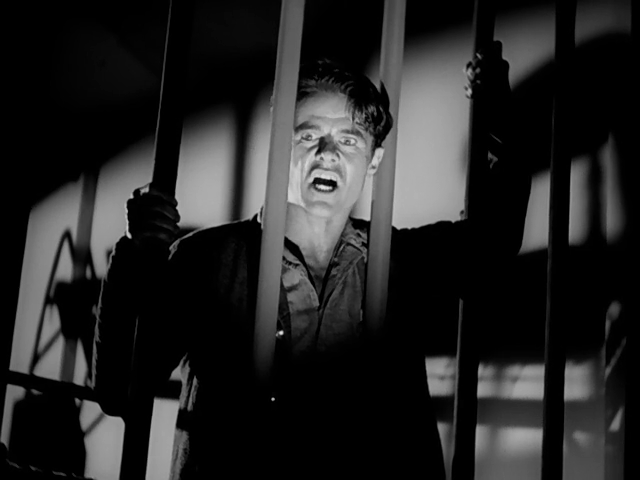
"Stranger on the Third Floor" (1940) is not a true film noir movie. It has many of the elements associated with film noir (heavy use of shadow, narration) and yet the mood of the picture is all wrong. I feel that this is a proto noir film. In other words, if noir films were a long running TV series, this film should be thought of as the pilot of the series. It is a pilot that is so different from the series that it could never be aired. Film noir is bleak and gritty. This movie has a kind of light and peppy mood. It even has a “gosh isn’t everything swell” happy ending.

The most noir part of this movie was the dream sequence in the middle of the film. While not exactly on par with the famous Salvador Dali designed dream sequence from Hitchcock’s "Spellbound," this sequence did have some notable aspects: the jail cell which seemed to be a kind of stage which was surrounded by darkness. The courtroom scenes during this sequence were much darker, the courtroom was empty, and the jury made no attempt to mask their indifference. After his sentencing, the electric chair was seen only as a gigantic imposing shadow. When the judge becomes the statue of justice, it is clear that this movie is hitting the audience over the head with its imagery and moving at a pace that is slow enough that you can go get popcorn and a soda and not really miss anything. To make matters worse, the image of the statue and the cheesy dramatic music that accompanies it are repeated just a few minutes after their first appearance.

The main theme of the movie: bad things can happen to anyone, is very noir. Michael would be a quintessential example of a noir hero, except for the fact that it is his girlfriend Jane ends up being the main focus of the action by the end of the movie. A secondary theme, and the one that resonated most deeply with me was, what responsibility do people have to each other? At first Michael feels he has a responsibility to testify against Briggs, but after he realizes how easily events can be misconstrued, he understands how easily duty and ethics can be misused. In Michael’s dream sequence, Jane throws right back at Michael the ethical argument he hid behind after testifying against Briggs, when she testifies against him and then tells him, “I had to tell the truth.”

This film is actually very pro-woman. Jane and women at large are made fun of for the majority of the film. Even her own boyfriend thinks of Jane as little more than a child. When Michael thinks about Jane’s reaction to Briggs’ trial he says, “she’ll forget about it in a couple of days.” He also asks her “What do you know about law and trials and such things?” However, by the end of the movie Jane emerges as the hero of the film when she tracks down the killer and gets him to confess.

This movie also shares the film noir theme of the city as corrupt. Every character in the film has been changed by the city into an uncompassionate sort of existentialist. Even the police are seen as indifferent. This is clear when Michael speaks to Jane about the police saying, “They wouldn’t listen to me if that’s what you want me to do.” However, the best example of the city’s utter indifference is the truck driver who kills Peter Lorre’s character. His defense for running over a man is, “I honked.” Jane is the only exception to the city’s indifference. Because she has not yet lost her compassion, Jane is a tortured figure. This is evident when Michael calls her after Briggs’ trial and she is hidden in shadows that represent her inner-struggles.

The voice-over/narration device starts off well. Michael asks himself, “Why do people live in Brooklyn? Why couldn’t I?” However, the device is soon so over used that it becomes comical. In general, this device is severely misused when it reveals character’s emotions that can more easily be revealed by his or her actions. As a screenwriter, one of the first lessons they teach you is “Show don’t tell.” In other words, if your character is shot you don’t write a voice over that says “Ow, I’ve been shot,” because it would be superfluous and silly.

This is the first of only three films that Boris Ingster would direct. This isn’t surprising because the film invokes a feeling of a boy experimenting with a new camera. This was most evident in the first scene at the diner where Michael and Jane are seen from their reflections in a mirror.

Worth mentioning is the sexual "dance" that Jane and Michael perform when she comes up to his apartment and light, airy music begins playing in the background. She’s all wet from the rain and begins to explore his apartment and talk. No matter what she says to him, Michael keeps asking her to take off her clothes and even starts taking them off for her. Then she starts playing along and asks him if he talks in his sleep, implying that they’ll be sharing a bed sometime soon. However, their good time is thwarted by Michael’s landlady and his milk obsessed, and ill-fated neighbor.

I also found this to be a hilarious dark comedy with many great one liners and some classic characters. The defense lawyer who seems to be on autopilot, the neighbor who imposes the virtues of milk on his neighbor, and the ill fated diner owner Nick who hits on the women sitting at his counter by revealing his “big” secret, a raisin in every cup of coffee. My favorite scene was during Briggs’ trial where both a jury member and the judge are asleep. One of the lawyers hears a jury member snoring, and wakes the judge. The judge immediately reprimands the juror for doing the exact same thing he himself was doing.

Despite it’s shortcomings this film was enjoyable and it is a great example of an intermediate step between the glossy themed Hollywood pictures of the 30’s and the gritty noir films of the 40’s.
Photobucket

Tuesday, August 16, 2011

Thoughts on "Double Indemnity"


Photobucket

This is my reaction paper from a college film noir class. Originally written in 2003.


Spoiler...

The first reason why "Double Indemnity" (1944), directed by Billy Wilder, is a classic film noir is the soundtrack, the music is tense and dark, and there is a common thread of it throughout the film. Every time Walter (Fred MacMurray) and Phyllis’ (Barbara Stanwyck) web of evil grows larger, the same theme starts playing in the background, almost like the ominous voice of some sort of inner conscience.

The second reason is the lighting in this movie is top notch noir lighting. Plot point number one, where Phyllis first comes over to Walter’s apartment and the seeds of their evil are sown by their first adulterous kiss, is the first scene that is only lit from outside of the room. The crisis/climax scene is another scene lit the same way. This time the only light is through a Venetian blind in Phyllis’ study.

The third reason why this is classic noir is the actor’s performances. Edward G. Robinson‘s Keyes, was the perfect foil for the intellectual machinations of Walter. Everything about Keyes’ physical presence was non-threatening; he can’t even seem to ever light his own cigar, and yet the wheels were always turning in his mind and it was clear from the first scene that he prized truth above emotions. You almost feel sorry for the man who got caught by Keyes for sabotaging his own truck, but Keyes shows him no mercy.

Walter has some great noir lines at the beginning of the movie. He says, “I killed him for money and a woman. I didn’t get the money or the woman.” Soon after that he says, “I never knew that honeysuckle could smell like murder.” He knows that Phyllis can only be bad for him, but he is drawn to her. He tries to keep his mind off her by bowling and drinking, but his thoughts never stray far from her ankles and her mysterious allure.

The writing of this screenplay was very tight. There isn’t a single wasted character or scene in the whole film. For a while I thought that the daughter Lola and her somewhat bizarre boyfriend Nino were nothing but filler, but by the end of the movie Lola manages to humanize Walter’s character and give him a little sympathy. While the revelation that Phyllis is having a relationship with Nino seems to make her that much more evil and inhuman. After Walter murders Phyllis, he stops Nino from going inside the house and possibly getting blamed for Phyllis‘ murder, which was Walter’s original plan. This is the resolution of the tension of the movie and the turning point of Walter’s character. We are left to wonder what changed in Walter’s character, did he give up? Did his love for Lola make him blindly act towards her happiness alone? We will never know.

The murder plan in this movie struck me as kind of dumb. I have no clue how someone who dies by falling off a train and someone who dies from being strangled can look at all similar. Another thing that bothered me was the fact that Walter and Phyllis always met in the same grocery store. If anyone with half a brain was watching either of them, I think they would have caught on really fast.

My final thought is of the slight homoerotic element that existed between Keyes and Walter. Whenever Walter says he loves Keyes, Keyes reacts by expressing his masculinity, almost as if he is afraid of such feelings. For instance he says, “Get out of here before I throw my desk at you.” Throughout the film Keyes dismisses Walter’s sexual conquests as robbing the cradle, he says, “I bet she drinks from the bottle.” Does Keyes unconsciously do this because he can’t accept the fact that Walter would have any real feeling for anyone but him? When at the end of the film Walter tells Keyes that he couldn’t find out the truth because, “the guy you were looking for was too close,” Keyes replies, “more close then you’ll ever know.” Then Keyes lights a match in the same way that Walter always did in the past as if to say that Keyes could have done it himself all along if he had wanted to, but it filled some kind of unconscious sexual desire.


Tuesday, June 21, 2011

Thoughts on Super 8...

Photobucket

Super 8 is a sort of a throwback to those great 80’s movies like the Goonies, E.T., Stand By Me, etc. The whole time I was watching this movie, I was remembering what those movies meant to me as a kid. This movie had that same magic, but I’m also old enough that I realized this film will belong to the kids of today in a way that it can’t for us adults.

One of my favorite elements was that the kids in the film are attempting to make a zombie movie. (You definitely have to stay for the credits during which they play the entire movie the kids made). I like how almost none of the events that happen around them such as the train crash, an evacuation of the town by the military, etc, deter them from their goal. Instead the director talks about production value and they film in front of the train crash or in front of the military personnel searching a house.

It brought back memories of when I wrote movie scripts and tried to film them with my friends (and sometimes my brother and my father too). The sad thing is I think the kids in the movie outdid anything I managed to film, but I’d like to think my scripts were better. I dusted off an old gem so you can judge for yourself. Dave and Stanley Scene: Bach Vs. Chopin

Ironically the premise of the first movie I wrote was that me and a bunch of my friends filmed a horror movie in our high school’s lunchroom during lunch using nothing but a Super 8 camera. The novelty of using such an old technology seemed like a neat idea. I guess I was about 11 years ahead of the trend.

The thing I remember best about directing is how you are in control, everyone from the actors to the cameramen are looking to you to tell them what to do. It is deeply scary and at the same time somewhat intoxicating.

Out of the cast I was most impressed with Elle Fanning who I thought gave an excellent performance that seemed wise beyond her years.

Super 8 definitely requires you to suspend your disbelief at times, but it is exciting and entertaining and I’d highly recommend it.

Sunday, June 5, 2011

Bridge Over the River Kwai


“The Bridge over the River Kwai” is a fantastic film. I recently saw it for the first time.

The movie takes place during WWII in Thailand. It starts out with British Col. Nicholson (Alec Guinness) efficiently marching his men into the Japanese work camp. Nicholson and his men are the prisoners, but they march in like kings. While they march they whistle the Colonel Bogey March, my personal favorite whistling tune, I remember learning it from “The Parent Trap” when I was a kid.

William Holden plays Commander Shears, an American POW that had been at the work camp for many months helping to build the barracks. He is one of very few men to survive; the graveyard around the camp is quite large. Shears tries to warn Nicholson that the Japanese commandant is insane, but Nicholson doesn’t listen. He is convinced that he must be a reasonable man. Nicholson is a true optimist while Shears is a pragmatist or a realist.

Nicholson refuses to let his officers perform manual labor on the bridge. He sees the officer’s job to organize the men. He cites the Geneva Convention and even pulls a copy of it out and offers it to the commandant, Colonel Saito (Sessue Hayakawa).

Saito hits him with the book and shouts “ Do not speak to me of rules. This is war, not a cricket game.” Saito puts Nicholson in a hot box and will not let him out until he relents.

Shears manages to escape the prison and returns to civilization. However, the British army recruits him to return to the work camp and blow up the bridge.

Back at the work camp, Saito slowly begins to realize that his project is way behind schedule and that it isn’t going to get any better. The prisoners are poor workers and do everything they can to sabotage the construction. Finally Saito decides to submit to all of Nicholson’s demands. It is a tremendous reversal, I thought Nicholson was completely over idealistic and I doubted that Saito would ever relent. Nicholson got lucky in my opinion; Saito was worried because failure to complete the bridge on time would force him to commit seppuku. A commandant from any other country would probably not be so concerned with his honor.

Nicholson quickly and completely takes over the bridge project. He and his officers redesign the bridge and motivate their troops. Saito is reduced to mumbling, “I have already given the order,” to whatever Nicholson suggests and throwing temper tantrums in his apartment when no one is around.

The bridge is completed the day before the deadline, but unbeknownst to Nicholson, Shears and a small strike force have just arrived to blow up the bridge. The small number of men with Shears are a stark contrast to the over 100 men who built the bridge. I couldn’t help but think how easily Nicholson and the others could have broken the chains that bound them if they’d tried. Instead Nicholson was seduced by the idea of building the bridge. When it was completed he imagined people using it for years after the war and he thought they’d remember that British soldiers had built it. He saw the bridge as one of the major accomplishments in his life. As a viewer, I was right there with him. War is hell, but a bridge is something good, something that is useful and can help people.

However, the commando team lays charges and is set to blow up the bridge as the first train crosses it. Nicholson and Saito find the wire the plastic explosives are attached to and trace it to the detonator. The green commando who is supposed to blow the bridge kills Saito with a knife, but tries to reason with Nicholson. Nicholson’s first reaction is to call the Japanese soldiers for help.

Shears races across the river while being shot at. He sees Nicholson and the two recognize each other. Shears dies, but seeing him is enough to bring Nicholson to his senses. He rushes over to the detonator and right before he dies from a mortar blast he manages to blow up the bridge.

The movie ends with the British doctor, Major Clipton, surveying the chaos of the destroyed bridge and the dead men strewn about the riverbanks. (He is kind of like Horatio at the end of Hamlet). All the doctor can say is, “Madness!”

Madness pretty much sums it up. Only in war could the destruction of something as seemingly positive as a bridge be the right thing to do. The Japanese and British learned to work together. The bridge was a testament to this and yet as long as the two countries were still at war there was no other option. Even Nicholson realized this in his last moments. He was so proud of the bridge, he’d almost forgotten he was still a soldier.

Wednesday, November 10, 2010

Some Details in "Back to the Future"...


Everyone has been celebrating the 25th anniversary since the debut of the movie "Back to the Future" and I'm no different. After all, I love the movie and watched it many times when I was a kid.

I watched it again a couple of nights ago and paid attention to some of the details in the film. You know, stuff I missed the first hundred times I watched it.

The first detail is the comic book the kid shows his dad in 1955, that proves that the DeLorean is a space ship and Marty in the radiation suit is an alien. "Shoot it, shoot it, it's already taken human form." I figured maybe it was a real comic, but it's just a creation. It really does capture the feel of the EC comics of the 50's doesn't it?


The next thing I wondered about was the movies that are featured on the marquee at the movie theater in 1955. The first one is "The Cattle Queen of Montana" starring Barbara Stanwyck and Ronald Regan which was obviously picked just because Regan was in it. "Ronald Reagan? The actor? Then who's Vice-President? Jerry Lewis? I suppose Jane Wyman is the First Lady! And Jack Benny is Secretary of the Treasury."

The movie on the marquee on the night Marty goes back to the future is "The Atomic Kid," a 1954 movie starring Mikey Ronney. The theatrical poster has the tagline "It's a laugh explosion" and a woman telling Mikey to "control your neutrons." That sounds kind of like a lost Doc line.


The next details are in the scene where Marty uses George's love of science fiction to convince him to ask Lorraine out. "I am Darth Vader from the planet Vulcan." George had fallen asleep while reading the fall 1954 issue of Fantastic Story Magazine, this time the robot kind of like Marty in the radiation suit. The difference this time is that it's actually a real magazine!

However, the music Marty tortures his dad with may or may not be real. As the tape Marty puts in says it is definitely Eddie Van Halen on the tape, but I'm not sure whether the clips are from. Some websites say "Eruption"others "Donut City" from the movie "The Wild Life" which stars none other then the original Marty, Eric Stoltz and Lea Thompson. Still other websites claim that the music is just some original riffs Eddie played just for the movie as a favor to record producer Quincy Jones. Since the last claim was said to be from the commentary track with Bob Gale and Neil Canton it just might be the true one.


Finally, when Marty goes back to 1985 and it turns out his whole family is happier and more successful because George learned to stand up for himself when he decked Biff. George gets a copy of his book in the mail.

The joke being that it looks like a retelling of how Darth Vader told him he had to date Lorraine.

But the book is proof that, "if you put your mind to it you can accomplish anything."


Monday, June 28, 2010

Thoughts about "On the Waterfront"

I feel really bad for "throwing it under the bus," because I think a lot of people love this movie, but I watched "On the Waterfront" over the weekend and I just didn't get why this movie is such a classic.

The first thing that really bothered me is the Leonard Bernstein soundtrack. During the film whenever anyone starts showing the slightest emotion the orchestral music swells and distracts from the acting. Basically, I wish I could have erased the music.

Yes, Marlone Brando gives a great performance, but I didn't think the script gave his character Terry Malone much growth. He starts off as kind of a dimwitted ex-boxer that only thinks about himself and by the end of the movie I guess we are supposed to think he’s learned to think about other people, but he testifies because the villain had his brother murdered, so has Terry learned altruism or simply revenge? In fact, I thought all of the characters where kind of one-note characters, the only other character with any growth was Eva Marie Saint’s Edie, who at the start of the film is a sheltered, but book-smart girl who doesn’t seem to have any experience with men and at the end of the film she’s fallen in love with Terry, but the movie doesn’t show how/if the relationship has made her grow/change.


My favorite scene without a doubt is the one where Terry and Edie are talking and she drops her glove. Terry picks it up and starts playing with it. I've always heard that this part wasn't scripted, but improvised. It really makes the scene because it's not just Brando that's improvising Saint is right there with him because at the end of the scene she pulls the glove off his hand and it all seems so natural, so real. Unfortunately it’s one diamond among a pile of coal.


Possibly the film’s biggest problem is that it can’t decide what kind of a villain Johnny Friendly (Lee J. Cobb) is. In his first scene, Friendly talks about how he started as a nobody and carved out a crime empire. This led me to believe he was an effective and smart villain. However, in the same first scene Friendly does two incongruous things: first he repeatedly refuses to count stacks of money saying it makes his head hurt. I let this go at first thinking he must be the hands-off type. Then someone else counts a stack and says a guy was short $50 bucks and Friendly goes nuts on the guy and tells him he doesn’t work in this town anymore. For someone who can’t be bothered to count his own money, the money sure means a lot to him. I guess we are supposed to think that the money doesn’t mean as much to him as trust does?


The next questionable scene takes place when it seems like Terry is going to testify. Friendly talks to Terry’s brother Charley. Charley is one of Friendly’s Lieutenants. Charley is the reason why Terry has always gotten a free ride, Friendly has kept Terry happy because it makes Charley happy and by that logic, Friendly is willing to do so much for Charley because he is a really great Lieutenant. But the fact that Terry might testify is just too much, Friendly gives Charley an ultimatum, he tells him he has to kill his brother or else. Now here comes the curious part, he lets him go take care of it on his own! If I was a really smart crime boss who had built a crime empire from nothing, I’d probably be pretty careful. If I’d given a man an ultimatum that backed him into a corner I’d probably be concerned he might decide to betray me. So you take a bunch of guys you can trust and you go with Charley and you make sure he kills his brother and if he can’t, you kill both of them. The one thing you don’t do is let him go off alone so he can formulate some sort of plan. Luckily, Charley did something even more boneheaded. He’s in the back of a car with his brother; up front some unnamed hoodlum is driving the car. Charley openly discusses betraying Friendly. You can see how horrified the driver is and so it is absolutely no surprise when Charley is dead a few scenes later. Did Charley think the hoodlum was loyal to him before Friendly? Maybe they were really good friends, and he trusted the unnamed hoodlum completely. But the unnamed guy had secret ambitions and his betrayal was not unlike Iago’s betrayal of Othello, a saga of unbelievable evil. But unfortunately the movie doesn’t give us the slightest hint.

Okay, the next scene of interest is the court scene. Terry gives about a two sentence confession on the stand. They ask him if he knows who killed Joe Doyle, he says Friendly ordered some guys to do it. That’s all he says and it seems that’s all the evidence the Crime Commission has: one man’s testimony. If Friendly was smart he’d understand that they still have nothing and all he has to do is play it cool. Instead Terry gets off the stand and Friendly goes into a blind rage and starts screaming at Terry and punching him. This outburst made him look guilty whereas the testimony hadn’t really been all that damning.

Okay, so Friendly and his boys are the Union leaders for the dockworkers. They make their money from…I never quite figured that out. Okay, so Friendly and his boys control whether a dockworker works on any given day. They also control what jobs any given guy has. We know this because Terry Malone was given a job where he doesn’t actually have to work. But the catch is that Friendly doesn’t own the boats or the cargo. That’s all owned by an overweight bald guy who we see only twice in the movie: First he is watching the court proceedings when Terry testifies. He just sort of grumbles when Friendly goes “ape-shit” on Terry afterwards. Then we see him at the end of the movie. He stands at the doorway to the docks and waits for the bloody and beat up Terry to report for work, because none of the workers will work unless he is working too. If the fat man didn’t somehow benefit from whatever deal he had with Friendly, why did he let him run the workers for so many years?

This movie’s director, Elia Kazan is legendary. I’m a big fan of his film “A Streetcar Named Desire,” but this movie was clearly an attempt by him to justify his testimony to the House Un-American activities Committee (HUAC). You see, Kazan was a Communist for a year and a half from 1934 and 1936. Then twenty years later, the HUAC was questioning “known communists” and trying to get them to name names. It was a witch-hunt and Kazan eventually caved and named 8 people. Then the following year he made this movie where the theme of the movie turns out to be how much of a hero you can be if you have the courage to testify. Knowing this background made what seems on the surface to be a movie about silly and evil mobsters seem to be about much more and it made it seem almost insidious, like if we thought Brando’s Terry Malone was right for testifying then we had to think Kazan must have been right for testifying too, right? Only they were two completely different situations. When I listened to Father Barry’s (Karl Madden) impassioned speeches about standing up to the union and having the courage to speak out, I thought they were kind of over-the-top, but when I think about them in the context of the HUAC, they absolutely disgust me.